Launch of a large-scale project to restore 25 kilometers of riverbeds along the Lutownia and Narewka rivers and 3,500 hectares of their catchments.

The expansive Białowieża forest is one of the last and largest lowland, mixed-broadleaf, virgin forests in Europe. Massive patches of old-growth forest and flooded forest cover the area, scattered with symbolic, giant, ancient oak trees. Spanning two countries, the forest is protected as a national park on both sides of the border, with the larger part, Bielaviežskaja Pušča, in Belarus and the smaller, Białowieża Forest, in Poland. The ecosystem is also physically divided by the border fence separating the two countries.
The protected areas, as well as several high-value mires and bogs in their periphery, are listed as a UNESCO World Heritage Site. In the 19th and 20th Centuries, many wetlands in the area were drained and several rivers straightened, which hugely influenced the status of the ecosystem. Water storage function was lost and the groundwater level significantly dropped with damaging knock-on effects on dominant native tree species such as oak, spruce, pine, and linden.
- Project: Rewetting Białowieża Forest
- Project size: 630 km² (Polish part), 1 418,85 km² (in total)
- Project leader: Monika Kotulak
- Project start: 2012 (in Belarus), 2019 (in Poland)
- Białowieża Forest
- Conservation Activities
- Milestones
- Partners
- back to top


Conservation Activities
Many of the conservation challenges and threats to the Białowieża ecosystem stem from anthropogenic changes to the area’s hydrology. Our focus since the beginning of the work in 2012 therefore has been to alleviate drainage pressure and bring the hydrological regime closer to its natural state. This is achieved by ‘re-meandering’ straightened rivers and blocking non-natural drainage channels. Restoring the natural hydrological regime is of key importance for the ecological functionality of the forest. So far, we have restored roughly four kilometers of the Salomienka river and 3,200 hectares of drained wetlands in Belarus.
In 2019, we started cooperation with Polish stakeholders – national park, forestry agency, and NGOs – on joint restoration efforts. In 2021, we have developed a vision for restoring hydrology of the Bialowieza Forest as a whole, transboundary area. Our work in Belarus was halted in 2022. Since 2023, we have been working on the ground in Poland. There, we have refurbished 31 damaged dams between until 2024, which now retain water in the forest.
In 2026, we have started the work to renaturalize 25 kilometers of river floodplains along the rivers Lutownia and Narewka and rehabilitate 3,500 hectares in the region by re-meandering rivers, connecting oxbow lakes and blocking ditches.
This will reduce drainage impacts, enhance water retention, and restore mire functionality. Consequently, the resilience of forest and wetland ecosystems to climate change will increase; ecosystem services, including water retention, carbon storage, and biodiversity will improve.
FZS and partners organize workshops and open lectures targeted at national park staff and other interested members of the community. These outreach events are focused on how the changes in hydrology influence on forests and its biodiversity and ecosystem services.
With the start of renaturalization activities in 2026, we are setting up a bigger communication campaign that includes activities of citizen science and awareness raising like exhibitions, guided walks and installing information boards.
Feasibility studies are conducted prior to our restoration work, while hydrology and biodiversity at these sites are monitored before, during, and after restoration. We measure several indicators e.g. groundwater level, greenhouse gas emissions, vegetation dynamics, amphibian, bat and bird abundance and biodiversity as well as beaver activity.
This allows us to continually assess the efficacy of the activities that we carry out and to adapt them if necessary.
Milestones
2026
2025
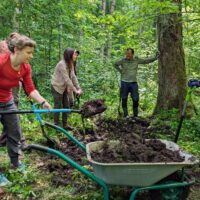
Start of work with local forestries and volunteers to close artificial drainage ditches in the Bialowieza forest.
2024
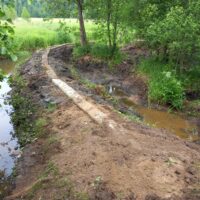
Repairs of further 17 dams are finished. They now retain more water in the forest.

2023
First practical work in Poland, refurbishing damaged dams for water retention.
2022
End of our work in Belarus.

2021
Work begins on updating the National Park Management Plan, and to develop a cross-border hydrological plan for the Białowieża forest between Belarus and Poland.

2019
Beginning of cooperation with Polish Białowieża stakeholders.

2019
330 ha of Dzikoe mire rewetted to create a buffer zone with agricultural lands and 4 km of Salomienka river in Belarus restored to its historical meanders.

2016
Restoration of the first 1,200 ha of the formerly drained Dziki Nikar mire in the Belarusian part of the park.

2013
First joint biodiversity research and monitoring launched including camera trapping, and research on forest-dwelling bats.

2012
Expansion of core zone of the Bielaviežskaja Pušča National Park in Belarus from roughly 30,000 ha to 60,000 ha.
2012
Start of FZS cooperation with APB – Birdlife, Belarus in and around Bielaviežskaja Pušča National Park.

1991
Expansion of the national park on the Belarusian side where it is known as the Bielaviežskaja Pušča National Park.

1979
Białowieża Forest, both in Poland and Belarus, declare a cross-border UNESCO World Natural Heritage site.

1932
Designation of Białowieża Forest as a national park on the Polish side of the border.
News from Poland
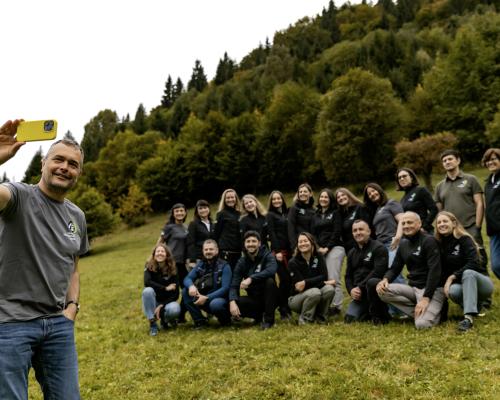
Michael Brombacher receives the IUCN Fred Packard Award 2025
10/10/2025NewsMichael Brombacher receives the IUCN Fred Packard Award 2025
A lifetime of field-based leadership and impact is honored with one of conservation’s highest recognitions. We are proud to announce that Michael Brombacher, Head of the Europe Department at Frankfurt Zoological Society (FZS), has been selected as a 2025 recipient of the Fred Packard Award by the IUCN World Commission … Read more
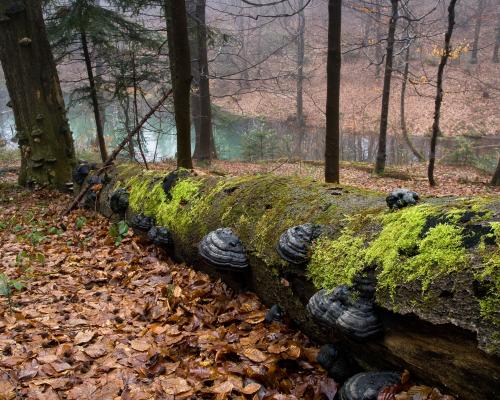
New stepping stones for wildlife in the Wolf Mountains
02/04/2025NewsNew stepping stones for wildlife in the Wolf Mountains
In the polish part of the Wolf Mountains, three new nature reserves are now under strict protection. All new areas have just been established in the Carpathians with its old-growth beech forests, protecting unique ecosystems with rare species. Although the new reserves are small, they stand for a change in … Read more
E40 waterway would destroy biodiversity hotspots and key protected areas, says new report
09/26/2022Press releaseE40 waterway would destroy biodiversity hotspots and key protected areas, says new report
Save Polesia Partnership’s stark warning: abandon E40 waterway megaproject or vital wetlands, grasslands, forests, and mires across Poland, Belarus, and Ukraine face catastrophe.


Project Partners
Successful conservation is always the result of great teamwork. We collaborate with local communities, national authorities, and conservation organizations. Our partners make our conservation work possible.
-


“In the Białowieża Forest, we can still experience nature in its most pristine form. We are committed to helping preserve its unique biodiversity and the natural processes of this extraordinary ecosystem for future generations.”