
Illegal snaring threatens wildlife in the Serengeti
Across the Serengeti, thousands of wire snares are set every year – silent traps that injure and kill wildlife indiscriminately. Lions, elephants, giraffes, and antelope can all fall victim. Many animals suffer for hours or days before they are found.
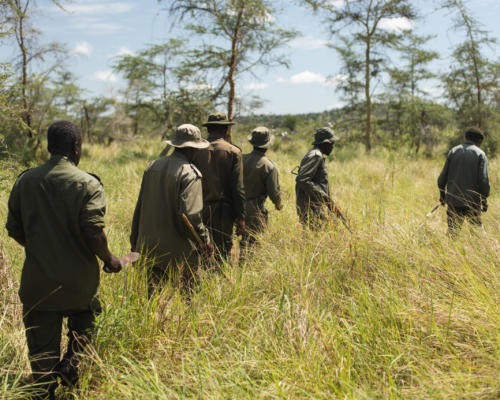
De-snaring teams work on the ground to find and remove these traps before they kill, free injured animals, and disrupt illegal poaching activity.
Your support keeps these teams in the field – protecting wildlife every day.

Why it needs dedicated de-snaring teams
Bushmeat poaching in the Serengeti often relies on simple but highly effective methods. Poachers set wire snares along well-used wildlife trails, especially near water sources or migration routes, where animals are most likely to pass. These traps are cheap to make, easy to conceal, and left unattended. Animals become caught by the neck or leg and may struggle for hours or days. Poachers return later to collect their catch, process the meat in the bush, and transport it to be sold in local markets.
Because snares are difficult to detect and widely distributed, they can continue killing long after they are set – making them one of the most persistent threats to wildlife in the Serengeti. The problem needs dedicated attention. This is why de-snaring teams patrol high-risk areas, remove wire snares, free trapped animals, identify poaching hotspots, and track down illegal camps where bushmeat is processed.
Each team includes two SENAPA rangers with law enforcement authority, six carefully vetted former poachers with deep bush knowledge, and one driver. Teams patrol high-risk areas on a 14-day field cycle, followed by seven days of rest.
Since 2017 the four operating teams have removed 100,000+ snares and freed more than 1,700 animals alive. But the job is not done yet.
What the teams have achieved
Why your support is needed now
Bushmeat poaching with snares remains a serious threat in the Serengeti.
Keeping one team in the field costs about USD 3,500 per month. More support means more teams – and fewer animals caught in snares.
De-snaring teams cannot end illegal snaring on their own, but they play a critical role in reducing its immediate impact and generating data that informs wider law enforcement action.
To meet this ongoing challenge, more support is needed. Your donation helps de-snaring teams in the field by supporting:
- patrol operations in high-risk areas
- fuel, food, and water for field deployments
- vehicle maintenance and transports
- essential camping and field equipment
- rapid removal of snares before they kill

Help keep Serengeti de-snaring teams in the field
Protecting wildlife from wire snares requires constant presence in the field. De-snaring teams patrol high-risk areas, removing traps and responding to threats as they arise. Your contribution helps sustain this direct and practical conservation work.
Every contribution directly supports practical, on-the-ground conservation.
You can also donate directly to FZS Tanzania:
Bank: CRDB (Cooperative and Rural Development Bank)
Account name: FZS Tanzania Donors Account
Account number: 0250 3011 79701
BIC/SWIFT: CORUTZTZ
Bank address: Meru Branch, PO Box 3132, Arusha, Tanzania
A strong partnership makes de-snaring teams possible
The Serengeti De-Snaring Programme is built on long-term collaboration between park authorities, conservation partners, and the tourism sector.
A key partner in this effort is the Tanzania Association of Tour Operators (TATO). Through financial contributions and ongoing engagement, TATO members actively support the programme and help sustain de-snaring operations. Their involvement reflects a shared commitment: the protection of the Serengeti is not only essential for wildlife, but also for the long-term future of responsible tourism in Tanzania.
Frankfurt Zoological Society works closely with the Tanzania National Parks Authority (TANAPA), which retains full management authority for Serengeti National Park. FZS provides the operational backbone that keeps de-snaring teams active in the field – from vehicles and equipment to logistics and coordination.
Supporting tour operators
-

-

-
 Kibo Guides Ltd.
 -

-

-

-

-

-

-

-

-

-

-
 Legendary Expeditions
 -

-

-
 Wild Frontiers Africa
 -
 Maasai Wanderings
 -
 Ranger Safaris
 -

-

-
 Tanzanian Experience
 -

-

-
 Altezza Travel
 -
 Alistair Logistics
 -

-
 Katja Willach Stiftung
 -

-



Frequently asked questions
De-snaring teams patrol high-risk areas of the Serengeti to locate and remove wire snares, free trapped animals, and identify poaching hotspots. Their work directly reduces the impact of illegal bushmeat hunting.
Wire snaring is one of the most widespread threats to wildlife in the Serengeti. These traps are cheap to set, difficult to detect, and completely indiscriminate, injuring or killing many different species.
Your donation helps keep de-snaring teams in the field by funding patrol operations, fuel, food, water, vehicle maintenance, and essential field equipment.
The programme is carried out in partnership between the Tanzania National Parks Authority (TANAPA), Frankfurt Zoological Society (FZS), and supporters including the Tanzania Association of Tour Operators (TATO).
Since 2017, de-snaring teams have removed more than 100,000 snares and freed over 1,700 animals. This is direct, measurable impact in protecting wildlife.
Yes. Snaring pressure remains ongoing, which means de-snaring teams must operate continuously. Long-term support is essential to sustain and expand their work.