

Launch of a large-scale project to restore 25 kilometers of riverbeds along the Lutownia and Narewka rivers in Bialowieza, as well as 3,500 hectares of their catchments.

Central European wilderness
Poland stretches from the sandy beaches of the Baltic Sea in the north to the forested Carpathian Mountains in the south. Large roadless areas and old-growth forests – habitat for wolf, Eurasian lynx, and brown bear – can still be found in the Carpathians. In the east of the country lies the world-famous Bialowieza Forest UNESCO World Heritage Site, one of the last European lowland primeval forests, which also stretches into neighboring Belarus. This transboundary forest is home to the largest free-roaming European bison population.
Nearly 20% of the country is protected by the Natura 2000 Network. The country’s wild landscapes provide key habitat for birds, including 25% of the world population of White Storks, and 25% of the remaining Aquatic Warbler. In the past, Poland held a rich mosaic of habitats resulting from traditional use, but currently, many of these landscapes are threatened by industrial development and urbanization.
Our focus areas in Poland
- Enlargement and establishment of protected areas
- Restoration and rewetting to re-establish the natural hydrological regime in the Bialowieza forest
- Promoting wilderness by communicating its benefits
- Supporting the East Carpathians UNESCO Man and Biosphere Reserve


Projects in Poland
-
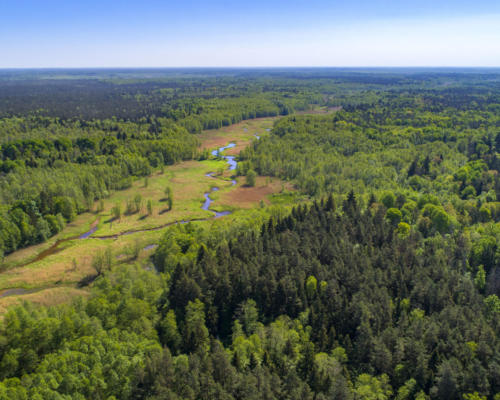
Białowieża Forest
One of the last and largest lowland, mixed-broadleaf, virgin forests in Europe
Poland stretches from the sandy beaches of the Baltic Sea in the north to the forested Carpathian Mountains in the south. Large roadless areas and old-growth…
Poland -
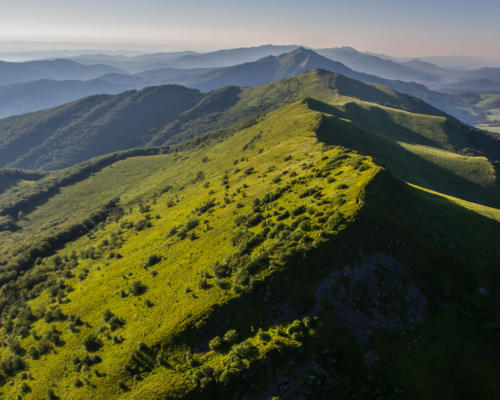
Wolf Mountains
One of Europe’s last remaining wilderness areas
Poland stretches from the sandy beaches of the Baltic Sea in the north to the forested Carpathian Mountains in the south. Large roadless areas and old-growth…
SlovakiaPoland
Milestones
2026

2025
Nature inventory of two areas to be proposed as nature reserves in the Wolf Mountains are completed: They cover 242 hectares. 60 species of funghi endangered in Poland have been found there.
2025
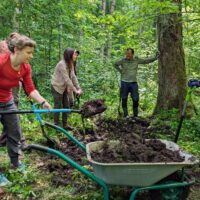
Start of work with local forestries and volunteers to close artificial drainage ditches in the Bialowieza forest.

2024
Establishment of two nature reserves in Poland “Kozie Żebro” and “Markowiec-Gródek” and enlarging the existing nature reserve ‘Zwiezło’ to over 484 ha, now named “Zwiezło w dolinie Olchowatego”. Documentation for two further proposed nature reserves “Piotruś” and “Stanków Łaz” submitted to relevant authorities.

2024
Repairs of further 17 dams are finished. They now retain more water in the forest.

2023
First practical work in the Polish part of the Białowieża forest, refurbishing damaged dams for water retention.

2021
Work begins on updating the National Park Management Plan, and to develop a cross-border hydrological plan for the Białowieża forest between Belarus and Poland.
2020
Start of cooperation with OTOP BirdLife Poland in the Wolf Mountains Program.

2019
Expansion of FZS work to Polish part of Bialowieza forest

2018
Start of FZS work in the Polish part of the Carpathians

2001
Strict protection of brown bears (since 1952 the species was partially protected)

1998
Strict protection of wolves in the entire country (partial protection in place since 1995)

1995
Strict protection of Eurasian lynx (Lynx lynx) is put in place in Poland. Establishment of Magurski National Park

1989, 1991, 1996, 1999
Enlargement of Bieszczady National Park

1998
Establishment of UNESCO Man and Biosphere Reserve East Carpathians

1979
Establishment of UNESCO World Heritage Białowieża Forest

1973
Establishment of Bieszczady National Park

1932
Establishment of Białowieża National Park