


Agreement on sustainable Saiga management reached at the CITES conference.

Protecting Kazakhstan's steppe ecosystem
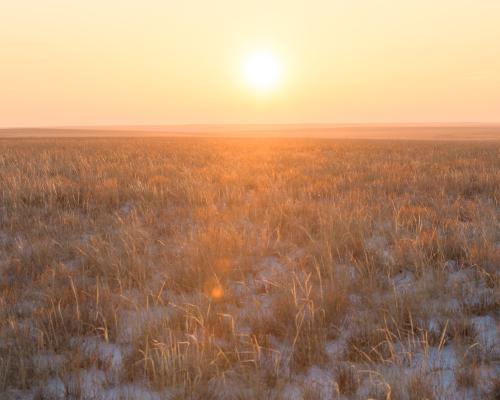
Kazakhstan, the ninth-largest country in the world, is home to an extraordinary diversity of ecosystems. Forests stretch across the north of the country, giving way to steppes, semi-deserts, and deserts further sout. The grasslands, which dominate much of this vast country, are among the world’s most threatened biomes. Here, every year, the ancient saiga antelopes undertake one of the most impressive mammal migrations in the Northern Hemisphere.
To the west lies the Ustyurt Plateau: here, isolated populations of Persian leopards still survive. They are a subspecies of leopard once widespread between Turkey and Central Asia, but now classified internationally as critically endangered. The Caspian Sea provides important resting and breeding grounds for waterfowl and waders, and birds of prey find an ideal habitat in the rugged cliffs.
In the east, the foothills of the Altai, Alatau, and Tian Shan mountain ranges form a rugged landscape that culminates in mountain ranges reaching up to 7,000 meters in height. On the slopes and in the valleys of these barren and often icy landscapes, a true master of survival hunts: the snow leopard.
Several Central Asian bird migration routes cross Kazakhstan. The wetlands in the center of this landlocked country are therefore important stopover sites for more than 300 species of migratory birds, including flamingos, pelicans, and the critically endangered white-headed duck.
What we do
- We are part of the Altyn Dala Conservation Initiative.
- We research the migration routes of saiga antelopes and protect their habitat.
- We are reintroducing wild horses and wild ass to Central Kazakhstan, thereby bringing back key species that had become locally extinct to the ecosystem.
- We support the training of local experts in wildlife and ecosystem monitoring.
- We advocate for the establishment and sustainable management of strategic protected areas.
- We enhance Altyn Dala’s visibility in national and international media.
- We mobilize financial resources to employ local staff and implement necessary conservation measures.


Our project in Kazakhstan
-
Altyn Dala – Protecting the golden steppe
Kazakhstan, the ninth-largest country in the world, is home to an extraordinary diversity of ecosystems. Forests stretch across the north of the country…
Kazakhstan
Project updates
Milestones

2025

2025
Six Przewalski’s horses are released into steppe wilderness after 200 years of local extinction.

2024
Altyn Dala Conservation Initiative wins prestigious Earthshot Prize.

2024
First overland transport of kulans is successful: 24 animals arrive well at “Alibi”.

2024
First cohort of seven wild horses from European zoos arrives in Alibi.

2024
First two kulan births in the wild after 100 years of local extinction.

2023
Kazakh Government initiates return of Wild Horses to Kazakhstan. Our fieldstation “Alibi” is chosen as reintroduction site.

2023
Saiga antelopes are down-listed from “critically endangered” to “near threatened” on the IUCN Red List of threatened species.

2022
Altyn Dala is recognized as “World Restoration Flagship” by the UN Decade on Ecosystem Restoration.

2021
Birth of the first kulan in central Kazakhstan after almost 100 years.

2021
Results from a survey by the Government of Kazakhstan show that saiga antelope populations have bounced back, now at nearly a million animals.

2019
The first cohort of nine kulan were reintroduced into Central Kazakhstan and Kazakhstan’s saiga population bounces back to over 300,000 individuals after the mass die-off.

2015
Betpak Dala saiga antelope mass die-off of more than 200,000 individuals ~88% of the national population and ACBK becomes a full partner in the BirdLife International NGO network.

2014-2016
Almost 2.5 million hectares of the new protected area was established in our target region including the first ecological corridor in Central Asia: the Yrgyz-Torgai-Zhylanshyk Ecological Corridor ~2 million ha

2014
Kazakhstan’s saiga population reached a size of more than 250,000

2009
ACBK leased two hunting areas that were particularly important in terms of saiga calving and migration (340,000ha)

2007-2012
Over 1.5 million hectares of new protected area was established in our target region

2006
The Altyn Dala Conservation Initiative was co-founded by FZS

2004
Our Kazakh partner, the Association for the Conservation of Biodiversity of Kazakhstan (ACBK) was established

1994-2005
Global saiga population declines more than 90% through heavy poaching for sale of horns and consumption of meat

1991
The collapse of the Soviet Union brought the collapse of strict hunting control system for saiga and rural poverty