The Serengeti is one of the last and largest functioning savanna ecosystems in Africa. Its defining characteristic is the large terrestrial mammal migration comprised of over two million wildebeest, zebra and gazelle. Their journey is at the heart of a landscape that supports extraordinary biodiversity and the livelihoods of millions of people.
Beyond the Great Migration, the Serengeti is home to elephants, wild dogs, lions, leopards, cheetahs, and critically endangered black rhinos. It also provides water, grazing land, and forest resources for millions of people while supporting thousands of jobs through nature-based tourism.
For more than six decades, we have worked to safeguard this remarkable landscape, not only within Serengeti National Park, but across the wider ecosystem, where protected areas, wildlife movements, and human livelihoods are closely connected.
The Challenge for Serengeti
The future of the Serengeti depends on what happens beyond the boundaries of the national park.
Across this landscape, the needs of agriculture, livestock grazing, tourism, infrastructure, and conservation must be balanced.
Long-term conservation therefore depends on shared responsibility, mutual benefits, and long-term partnerships with the communities that live and work across the Serengeti landscape.

The work of FZS in Serengeti
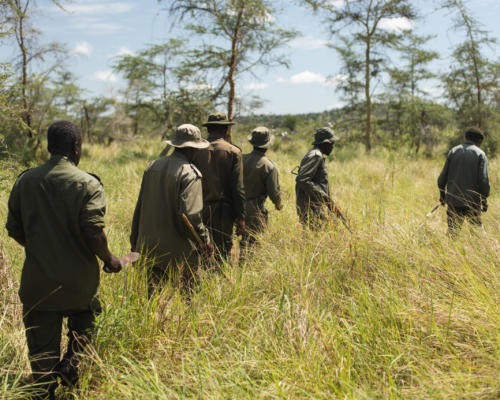
We support ranger operations through vehicles, aircraft, and a digital radio network connected to park headquarters in Seronera. Together with Tanzania National Parks (TANAPA), we strengthen monitoring, infrastructure, and protection across Serengeti National Park.
A major focus is resource protection, including supporting specialized de-snaring teams that remove thousands of wire snares – intended to hunt wildlife- every year.
We continuously monitor the impact of our conservation work and adapt our strategies based on evidence and long-term learning, helping ensure our efforts remain effective in a changing environment.

Partnering with Communities in the Serengeti

Many decisions that shape the Serengeti are made outside the national park.
Together with communities, government authorities, and local partners, we develop long-term solutions that benefit both people and wildlife.
More than 70 communities have developed land-use plans that balance farming, livestock grazing, settlement development, and habitat conservation. Through Community Conservation Banks (COCOBA), families can save, access small loans, and invest in their livelihoods.
Together, long-term land-use planning and Community Conservation Banks strengthen local livelihoods while supporting conservation across the Serengeti landscape.
Protecting Black Rhinos in the Serengeti
Every black rhino matters.
With only a small population remaining in the Serengeti ecosystem, protecting every individual is critical. We support dedicated rhino ranger teams, veterinary care, and modern telemetry technology and analytics that enables rangers to monitor animals across vast landscapes.
By combining field expertise with long-term commitment, we help give black rhinos the best possible chance to thrive in the wild.


Removing Wire Snares in Serengeti
Wire snares remain one of the greatest threats to wildlife.
Together with the park authorities, we support specialized de-snaring teams recruited from nearby communities that locate and remove snares before animals are injured or killed.
More than 100,000 snares have been removed since this program began.
Project Partners
Protecting the Serengeti is only possible through strong partnerships. Together with government authorities, local communities, conservation organizations, donors, and supporters around the world, we are helping secure the future of one of Earth’s greatest wildlife landscapes.
-
 Wildlife Division of the Ministry of Natural Resources and Tourism of Tanzania
 -
 Tanzania National Parks (TANAPA)
 -
-
 Tanzania Wildlife Authority (TAWA)
 -
 Tanzania Wildlife Research Institute (TAWIRI)
 -
 Pasiansi Wildlife Training Institute
 -
 Mweka Wildlife College
 -
-

-
-
-
JRS Biodiversity Fund
-

-
-
SENAPA Investors
-
Eleonore Beck Foundation
-
 Friedkin Conservation Fund
 -
Asilia Giving
-
Stadler Family Foundation
-
Manfred-Hermsen Stiftung
-
 The Wildcat Foundation
 -

-
-

-
-
-
 Dvůr Králové Safari Park
 -
World Nomads
-


Protecting the Serengeti takes long-term commitment
Protecting the Serengeti takes long-term commitment
Your donation supports on-the-ground conservation efforts – protecting threatened species, securing vital wildlife corridors, and working with the people who live in and depend on this landscape.
Together, we can help ensure that one of the world’s most important ecosystems remains a home for wildlife while supporting the livelihoods of millions of people.